What is bookmatched marble? A guide to mirrored veining
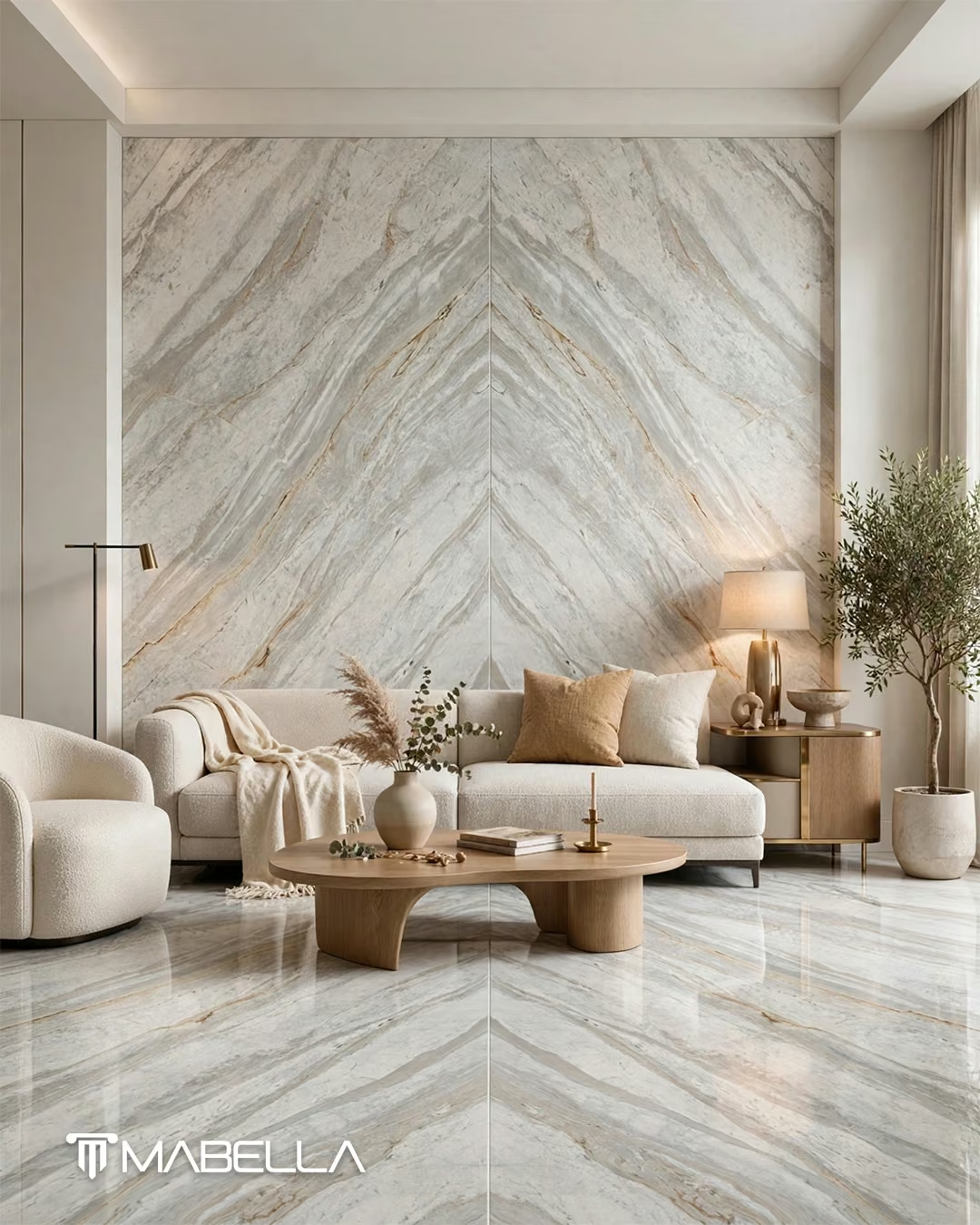
Bookmatching is the pairing of suitable slab faces so that, placed side by side, they form a mirrored vein composition. The effect is not achieved simply by turning stones over during installation; slab selection, the direction in which the faces are finished and the cutting plan are considered together. Not every marble slab gives an equally pronounced bookmatch.
Where does a bookmatch create a meaningful focal point?
A wide wall, an uninterrupted surface behind a countertop or a prominent entrance wall gives the composition room to be read. If there are many doors, sockets or gaps between cabinets, the pattern can be broken up. Start the design by placing the mirror axis. Then look at how that axis relates to the furniture and the architectural elements. Centring the symmetry on the wall is not always right; the room's line of sight can matter more.
Move from a slab photograph to a buildable plan
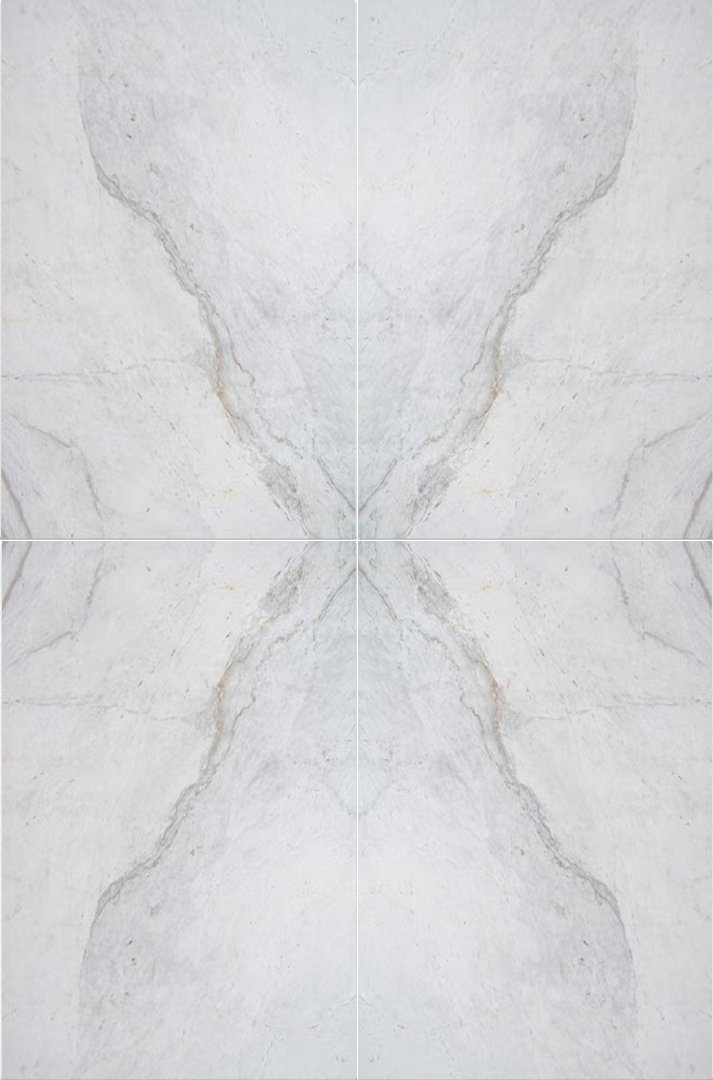
Real photographs of the two slabs should be prepared at the same scale, with the slab codes and the faces to be used marked. Mirroring the photographs digitally does not show that matching faces are available in production. The supplier and the fabricator should confirm the faces to be matched, the usable dimensions and the state of finishing. The cut lines of the composition you liked on screen should also be visible.
Cuts and joints are part of the pattern
The centre joint, edge returns and openings should be drawn in. How much usable area a symmetrical pattern needs is calculated from the actual slabs. It would be wrong to give a fixed waste rate that applies to every job. Some pieces cannot be used elsewhere because they are kept to protect the pattern, and that can affect the scope of a quotation.
What should the approval drawing show?
Put the wall dimensions, slab identities, direction arrows, joints, cuts and visible-face markings on the same sheet. Do not approve only an attractive render. Ask for a plan from which the installer can tell which piece goes where. On projects where it is possible, compare dry-lay photographs with the design approval. This reduces differences of interpretation once the stone reaches site.
Bookmatching and vein continuity are not the same goal. The first is about the mirrored relationship; the second about visual flow across the surface. When you talk to Mabella, show the effect you want with a reference image, and have the suitable lot and production possibilities confirmed separately.
Source for the basic concept: Use Natural Stone, a Natural Stone Institute initiative — Bookmatching (opens in a new tab).
Frequently asked questions
Can every marble be bookmatched?
It needs suitable faces, dimensions and a pattern relationship. The visual effect is judged on the actual slabs.
Does digital mirroring count as production approval?
No. The actual slab faces, the finishing direction and the cutting plan must be confirmed by the fabricator.