The source of Volakas marble.
Drama, Greece.

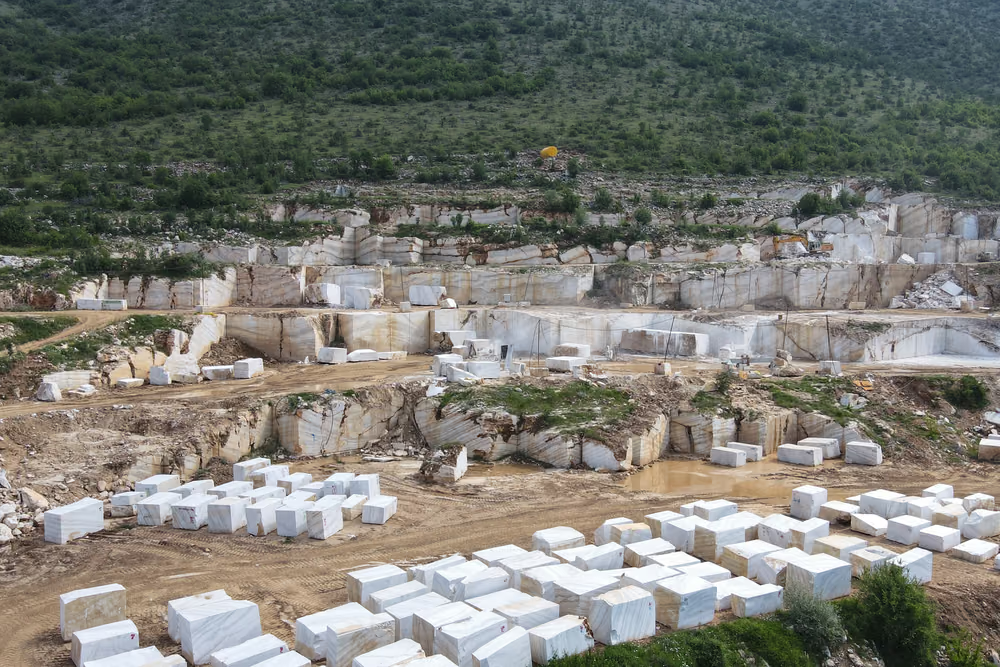
At our Ohiro marble quarry in the Drama region of Greece, we come to know the character that Volakas marble takes from its natural formation, right at the source. Its grey veins, moving in their own way across a white ground, give every block a different look.
At Mabella we follow natural stone from the point it is extracted; we manage block selection, material assessment and production with the stone’s own structure as the basis.

A different character,
born in every block.
Volakas marble is a natural stone that carries the traces of its metamorphic formation and takes its character from the grey vein transitions on a white ground. These differences, which come from its geological formation, set every marble block apart in colour distribution, vein density and the movement of its pattern.
At Mabella’s marble quarry in Drama, blocks are assessed against the criteria of vein structure, natural continuity, size and workability. This first assessment at the quarry plays an important part in determining the visual character of the slabs produced in the later stages and their potential use in architectural projects.
The unique character of natural stone begins to be understood while it is still in the quarry.
From the source to production.
A planned process.
Extracting Volakas marble from the quarry, assessing the blocks and preparing them for shipment are operational stages that complete one another. At every stage, the structural properties of the natural stone and the requirements of the processing that follows are taken into account.
Production Suited to the Geological Structure
The stepped structure of the quarry gives controlled access to the layers where the marble lies. Production areas are assessed in line with the geological properties of the natural stone and the conditions for extracting blocks.

Preserving Natural Integrity
Masses of marble are separated from the parent rock according to the production plan and turned into blocks. During extraction, the direction of the stone’s veins, its dimensions and its natural structure are taken into account.

Every Block Is Assessed Separately
The blocks taken from the quarry are examined for their dimensions, vein character and visual properties. Identification and numbering make the blocks easier to follow through the later stages.

From the Quarry to the Production Plant
The selected marble blocks are prepared for shipment according to their properties and their planned use. Determining the right material for slab production and project-specific processing is an important part of this stage.
Its natural character.
Known through technical data.
When Volakas marble is considered for architectural projects, knowing its physical and mechanical performance matters as much as its visual properties.
The laboratory examinations carried out to this end provide data for determining the marble’s technical properties, such as compressive strength, flexural strength, density, water absorption and abrasion resistance.
The test results obtained by the Natural Stone Analysis Laboratory of Afyon Kocatepe University allow the material properties of Volakas marble to be assessed through technical data.
These data are a technical reference that architects, engineers and project developers can turn to when selecting materials. Suitability for the final use should be assessed separately, in line with the project’s conditions and the relevant technical requirements.
Volakas Marble — Laboratory Test Results
Natural Stone Analysis Laboratory, Afyon Kocatepe University · report no. 25183, 3 March 2026
- Compressive strength
- 146 MPa
- Flexural strength, under constant moment
- 5.46 MPa
- Apparent density
- 2812 kg/m³
- Water absorption, at atmospheric pressure
- 0.36%
- Abrasion resistance
- 22.23 mm
The test results belong to the specimens examined. For the test methods, specimen details and a detailed assessment of the results, please refer to the technical report.
The right Volakas
for your project.
Every architectural project has its own material requirements in terms of dimensions, vein structure, colour consistency and area of use.
With material knowledge that begins at its marble quarry in Drama, Mabella supports the assessment of Volakas block and slab options to suit the needs of a project.
Share the technical details and material expectations of your project with us. Let us determine the natural stone alternatives that suit your needs together.