What to look for when choosing a marble kitchen countertop

The first criterion in choosing a marble kitchen countertop is whether you accept that a natural surface changes over time. Besides the look of the stone, the way you prepare food every day, your cleaning habits, the cut-outs and the support details all affect the decision. Choosing from a kitchen photograph alone leaves your expectations of use undefined.
Describe how you use the kitchen every day
Do you mostly use the countertop for serving, or for heavy food preparation? Do you accept some of the marks of everyday life as part of natural use? Are chopping boards and coasters realistic for you? Answering these questions honestly makes the choice easier. Not every user has the same expectations of care, and aesthetic preference alone does not determine the right material.
Take acid sensitivity into account
On marbles that contain calcium carbonate, contact with acid can dull the surface. That is not always the same as an absorbed stain. Understanding this property before choosing a kitchen surface helps you judge marks correctly when they appear. For the basic approach to care, see the Natural Stone Institute's care guide (opens in a new tab).
Plan the sink and hob cut-outs together
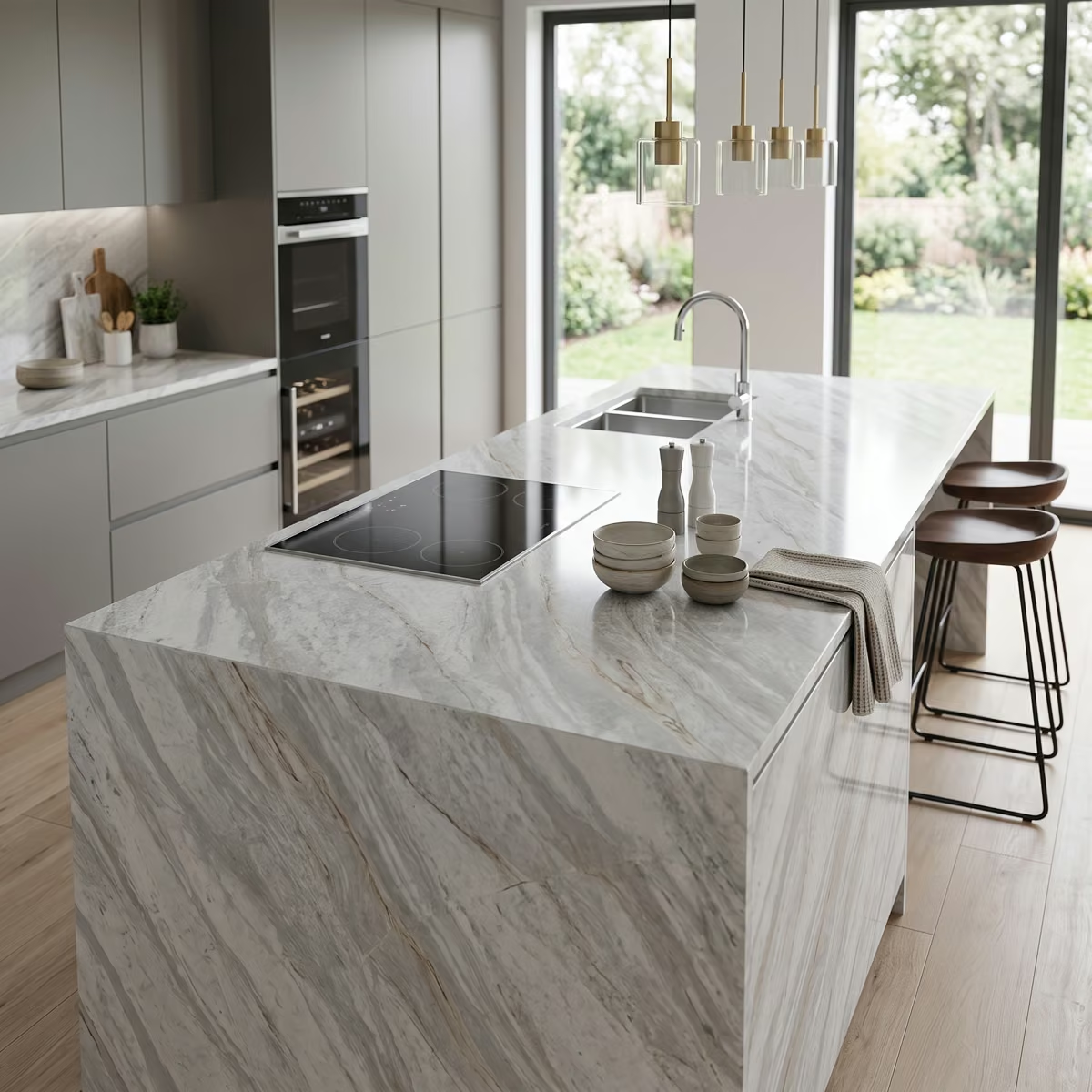
Show the sink, hob and tap holes on the slab. The position of joints and the support arrangement should be worked out with the fabricator. A thick edge seen in a photograph does not prove the whole countertop is that thick; different fabrication details can produce a similar look. Do not take dimensions for the supporting structure or spans from an image.
Choose the critical viewpoints for visual approval
The front edge seen from the entrance, the area around the island and the wall behind the countertop may be the most noticeable. If you are using a veined slab, see where the pattern will end up after cutting. Assess the cabinet colour and the metal finishes together with the slab photograph. A countertop and a wall in the same stone does not mean the veins will continue by themselves.
Complete the scope of the quotation
Ask which of measuring, transport, removal, installation, cut-outs, edge work and the handover of care information are included in the price. Do not compare the price of the stone alone with the price of the finished job. Get the names of the care products you will use after installation, and how to apply them, in writing.
When you discuss countertop material with Mabella, share the kitchen plan, approximate dimensions and how you expect to use it. Have the installation scope and the fabricator's responsibilities clarified separately; a material being offered for sale does not mean that every countertop detail is automatically approved.
Frequently asked questions
Is every dull mark on marble a stain?
No. Dulling of the surface and discolouration that has worked its way into the stone can have different causes.
Does a thick-looking edge mean a thick slab?
Not always. Ask separately about the edge fabrication detail and the actual slab thickness.